4/5 ****
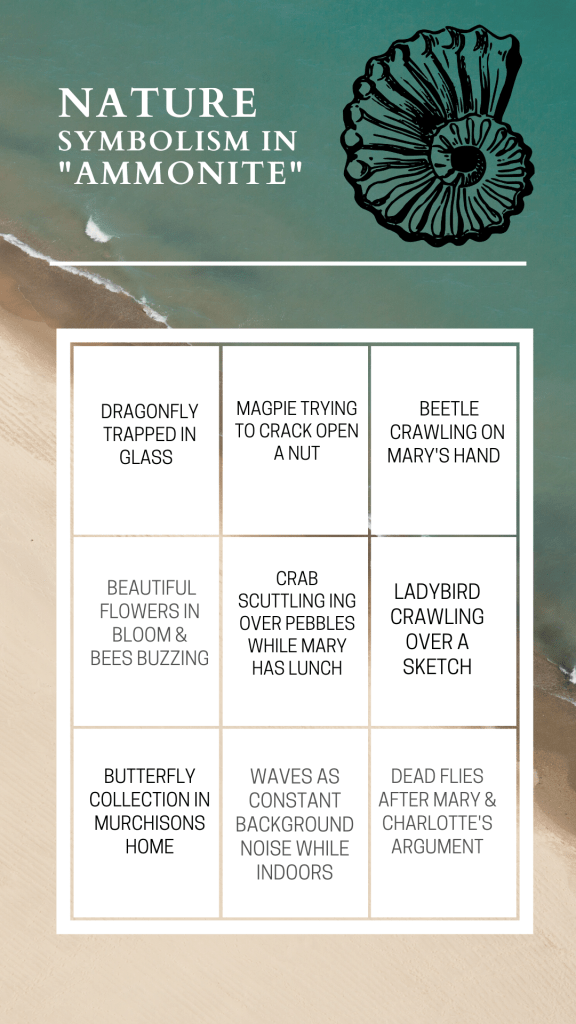
Working class palaeontologist Mary Anning (Kate Winslet) falls in love with upper class married woman Charlotte Murchison (Saoirse Ronan) in 1840s Lyme Regis. I made it my mission to notice all the aspects of nature that Francis Lee included and recorded them in the table below.
An upper class man comes into Mary Anning’s curio shop, claiming to be a huge fan. Clearly unimpressed with the fanfare, it seems as though Mary has resisted the cult of celebrity that first came hand in hand with her discovery of a famous ammonite. As they talk, Mary admonishes the man’s wife, a nervous Charlotte Murchison, who is clumsily inspecting ammonites on the shop floor.
Cold relationships characterise the initial part of this movie. Although they live together in the shop, Mary and her mother barely exchange two words. They don’t have much money and the strain of this can be keenly felt. At one point Mary watches a group of upper class women out shopping, while she remains inside excavating and mending shell inspired crafts that put food on the table. As her mother looks out at the same scene, it is clear that something has happened to create this gulf between them, whether it is because she chose a different life to the one expected of her or because of something else.
In the meantime, Charlotte finds herself trapped in a cold marriage with a man who seems to have saved all of his warmth and enthusiasm for his own excavating hobby. A dragonfly trapped in a glass in their hotel room reflects the cage she finds herself in. In bed, Mr Murchison rejects her appeal for intimacy, saying it is ‘too soon’ for another child. The implication is that they have recently lost a child and this would go some way to explaining Charlotte’s depression or ‘melancholia’ as it was described then. When she tells him she doesn’t want to be alone, he leaves her alone in Lyme Regis. “I want my bright, funny, clever wife back” he says – although he plans to take no part in bringing about this restoration personally.
Before departure, Mr Murchison pays Anning to take Charlotte out on her fossil finding walks, hoping this will bring her back to life again. The first time Mary and Charlotte walk to the beach was really affecting for me. Anyone that has been through profound grief can practically feel Charlotte’s grief as she sits alone on the rock, looking out to sea, in her mourning clothes. She has been prescribed ‘sea air’ as her remedy.
Charlotte soon becomes very ill and a visiting doctor tells Mary she will have to look after her. When she resists, the doctor says “It is a woman’s position to care for a fellow sister, is it not?”. Mary decides that it is, taking Charlotte in and nursing her back to health.
Once she is well again, the real adventure begins. Mary teaches her about her work. She talks about the ammonite she discovered, which now lies behind a glass case in the British Museum. She says it has been given a fancy latin name, the Itchthyosaur. I found this interesting as this was a topic we had touched upon in nature writing class – how nature writing that describes everything in their latin names can seem exclusive to those who were never taught the language. While I don’t know what the scenario was in the 1840s, I do know that latin education has not been taught in British state schools since the 1980s and has become the privilege of the few that are educated in private school.
Weeks of excavation becomes the foreplay for a passionate love affair. Both women lift each other out of their cold existence and find the passion and intimacy they have been missing. But eventually Charlotte’s marriage and the class problem can’t be ignored. Mary accuses Charlotte of putting her in a ‘gilded cage’, much like the cage Charlotte herself has been trapped in due to her oppressive marriage.
Charlotte doesn’t want to believe they cannot come overcome these obstacles. “I want this to be different, our different”. This film offers us hope that it will be.
Nature symbolism
Apparently nature symbolism is common in Francis Lee’s movies, such as God’s Own Country. I haven’t seen it but will certainly be going on the list.
After watching this film, I found a thread where people were trying to derive meaning from every aspect of nature that is included. I think for the most part the director is simply trying to instil the similar sense of wonder and attention to detail that our protagonist already possesses. Lee makes the experience a sensual one, from the waves and birdsong, to the colourful flowers and close up shots of creatures and insects that you might not ordinarily notice underfoot.
I personally think the ladybird motif is a nod to Saoirse Ronan’s performance in Lady Bird, for which she won a golden globe. But I’m sure there are other interpretations out there…
I put together my initial noticings in the below table. Did you notice anything interesting I might have missed?
No doubt I’ll see more during a second watch!
 burrowing